
God Goes to the Oscars
What an overlooked category has to say about the Almighty


In the middle of a busy week, I found myself in a movie theater less than an hour after I got off work. If I’m being honest, I didn’t really want to be there. A night in sounded better to me than yet another night out. My wife and I weren’t even there to see a movie, but a screening of the Oscar-nominated animated short films. Why did I agree to this? It seemed like a cultured thing to do when we first bought our tickets, but as I sat in the theater waiting for the show to start, I couldn’t help but wonder how much more comfortable I’d be at home.
All those thoughts vanished as soon as the short films started playing. Somewhere in the second short, I realized there were few better ways to spend my evening.
Beyond the impressive level of craft on display in these animated short films, something more held my attention. Some of the shorts explicitly or subtly portrayed or alluded to the Bible. Apparently God was invited to the Oscars this year! While some of the night’s biggest films wade into the waters of religion (Sinners in particular), these animated shorts surprised me by their willingness to ponder the deep things of life like death, commerce, and, yes, God.
While all the nominated animated short films are worth watching, I chose to only write about the three with the most clear references to God or the Bible, which also happen to be the three that moved me the most. Here are three mini reviews for my three favorite Oscar-nominated animated short films.
“Forevergreen”

“Forevergreen” tells the story of a bear and a sequoia tree who develop a wholesome parent-child relationship. That relationship gets tested, however, when a discarded bag of potato chips tempts the bear with the allure of salty processed foods. With one character being a bear and the other a tree, it should come as no surprise that “Forevergreen” is devoid of dialogue.
What it lacks in dialogue, however, it makes up for in music. Folksy and prominent, the music of “Forevergreen” stood out to me as I watched the charming short film. Twinkling mandolin riffs and twangy banjo lines complemented the nature-based story. Then, near the end of the film, a voice started singing. It was the unmistakable voice of Josh Garrels, one of the most celebrated Christian singer-songwriters. I’ve been a fan of Garrels’ work for years, so it was a welcome surprise when his crooning voice came over the speakers of the theater. It turns out Garrels worked on the music for this short film off and on for the last six years.
The story is the most straightforwardly Christian story of animated shorts. It tells a story of sacrifice and ends with a title card displaying the text of John 15:13: “Greater love has no one than this, that someone lay down his life for his friends.” Nathan Engelhardt and Jeremy Spears, the co-directors and co-writers of the short film, worked on projects like Big Hero 6 and Zootopia 2. It was very cool to see such an explicitly Christian short film with a score by a Christian singer-songwriter get an Oscar nomination. If you liked 2024’s The Wild Robot, you’ll like “Forevergreen.”
The short film may be viewed in its entirety on YouTube.
“The Girl Who Cried Pearls”
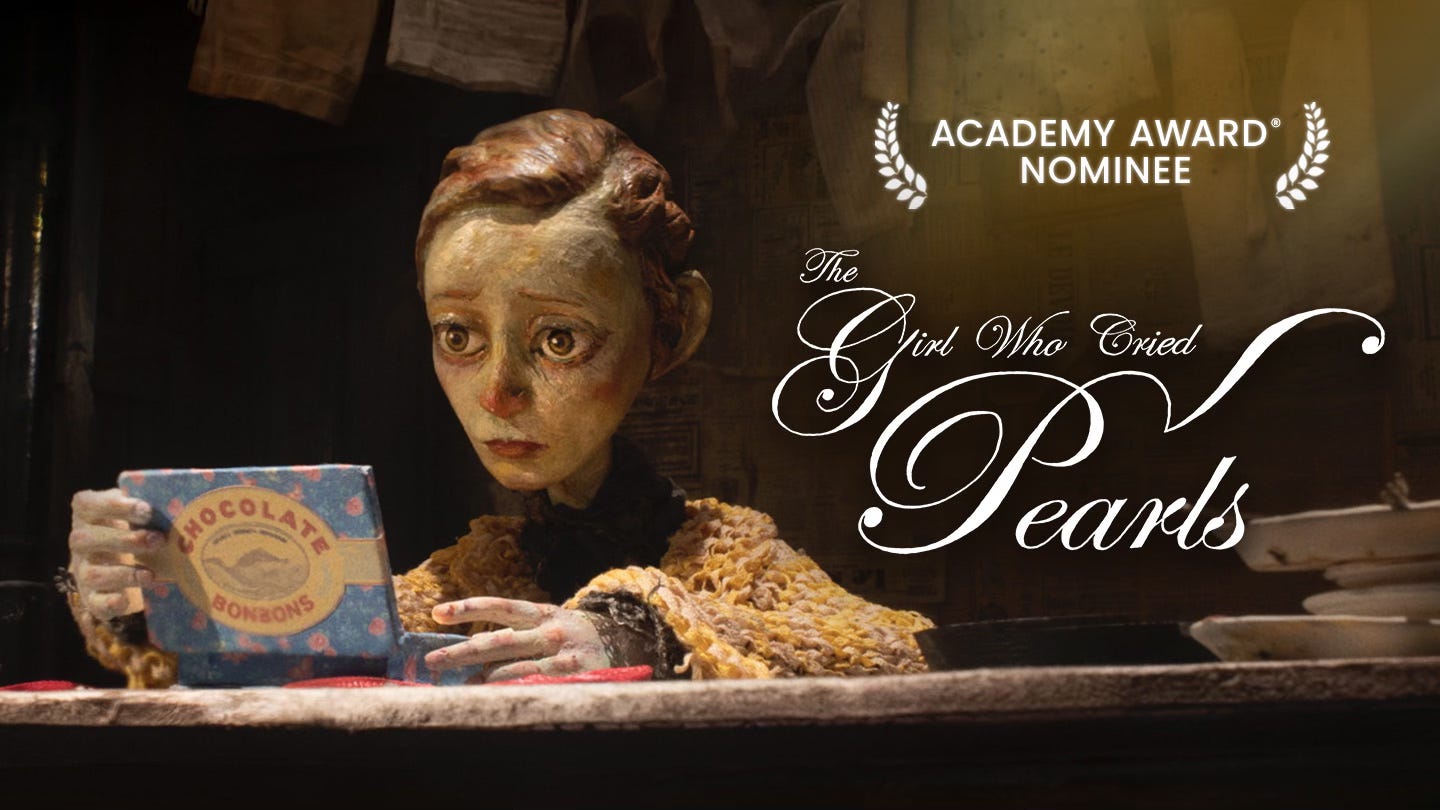
Forsaking the warmth, sacrifice, and pleasing shapes and textures of “Forevergreen,” “The Girl Who Cried Pearls” is a cold story about selfish people with an animation style that sets the viewer on edge.
The short film opens on a young girl who finds a pearl in her grandfather’s office. The grandfather enters and starts telling her the story behind the pearl. When he was a young boy, he had no parents or guardians to lean on and eked out a life of Dickensian wretchedness on his own in the early 1900s. In the winter, he’d find a vacant apartment, and sleep as close as he could to the wall, hoping some family would light a stove and inadvertently bless him with a modicum of warmth. One winter, as he spies on the family next door, he watches the daughter, perhaps a little older than he is, cry herself to sleep most nights. As she cries, her tears miraculously turn into pearls. He takes two of these pearls to a pawnbroker who, in turn, takes them to a jeweler. The learned Jewish jeweler tells the pawnbroker of a legend that after Adam and Eve had been banished from Eden, Eve cried pearls.
I had never heard that fascinating legend. Paired with the obvious borrowings from Jesus’ parable of the pearl of great price, “The Girl Who Cried Pearls” was a fascinating short film. It’s much darker and less straightforward than “Forevergreen.” A twist near the end throws much of the story into doubt. With its musings on charity, miracles, and the treacherous love of money, this short film offers plenty for Christians to puzzle over.
At the moment, the Canadian-made film is a little hard to stream here in the States. It could probably be purchased or rented online somewhere. If you can wait a little while, it’ll probably be easier to stream after the Oscars fever dies down.
“Papillon” (Butterfly)
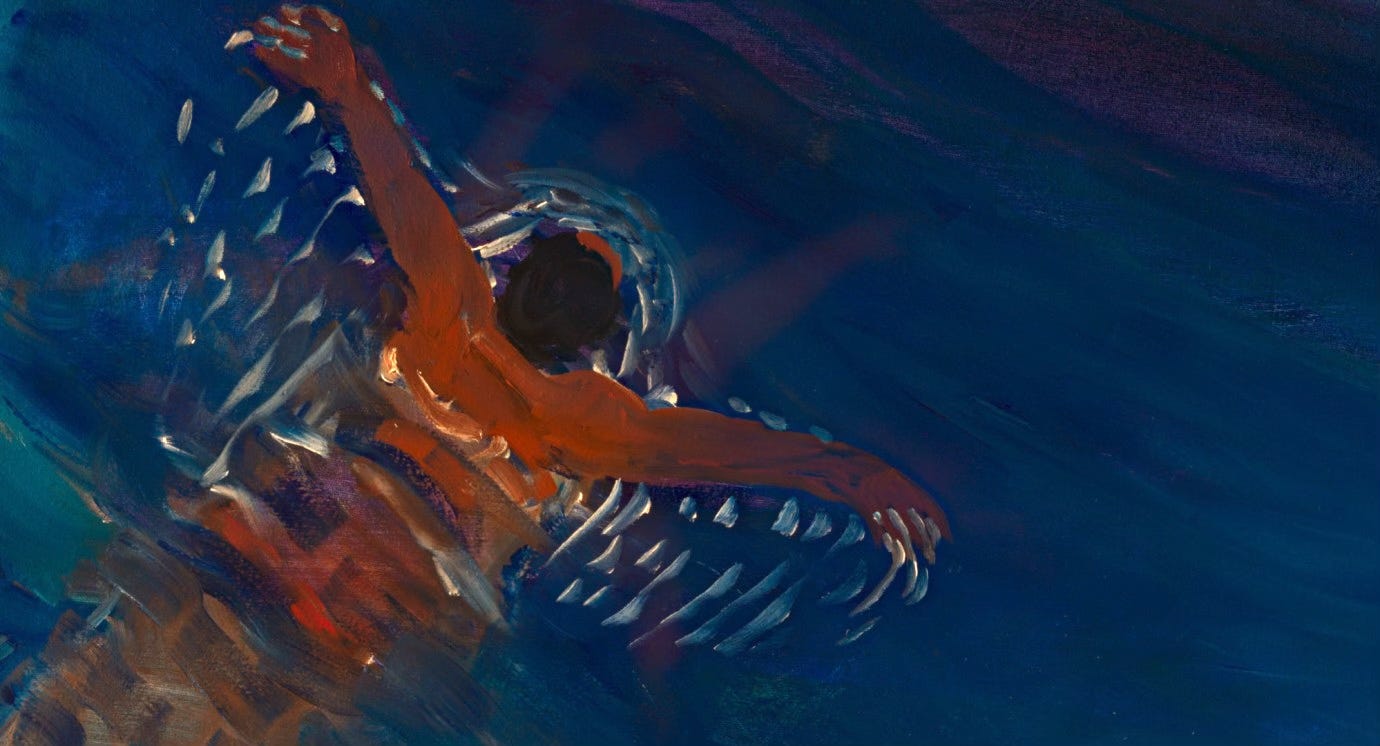
“Papillon” or “Butterfly,” is far and away the best of the five nominations. I hope and expect it to win the Oscar for best animated short film. Through gorgeous impressionistic oil painting animation, the film centers on a man in different bodies of water throughout his life—the tub, an Olympic swimming pool, the ocean. The man is Alfred Nakache, a real-life Jewish French swimmer. The story moves as effortlessly as a body in water, showing Nakache overcome a fear of swimming, win competitions, and fall in love. Then, Hitler comes to power, and Nakache soon fears for his family’s safety and competes in the infamous 1936 Olympics in Berlin. Nakache’s story is one of great tragedy, but not defeat. He endured the horrors of a concentration camp, but he survived the war and swam again in the 1948 Olympics. The short film’s animation is the most beautiful and impressive of the nominated bunch. Its storytelling is more mature, trusting the audience by not spoonfeeding plot beats or morals. It’s timely without being preachy. Moreover, the director has a personal connection to Nakache. She met him when she was 10 years old and swam with Nakache’s younger brother. She renders Nakache’s story wonderfully.1
While “Papillon” makes no explicit reference to the Bible (at least, not one that I caught), I couldn’t help but think of the Bible’s preoccupation with water. From the flood, the splitting of the Red Sea, to Jesus walking on the water, to the banishment of the sea in Revelation—water is ubiquitous in the Bible. Noah’s family, the Hebrews, the disciples, Dietrich Bonhoeffer, and Alfred Nakache found life and death in the water. Water, in fact, ties these short films together. From the river that runs in the idyllic valley in “Forevergreen” to the tears that run down the titular girl’s face in “The Girl Who Cried Pearls.”
Water is mysterious and enigmatic. It seems to move with a life of its own. Water can be gentle and playful at one moment, and utterly deadly the next. Water conceals, crushes, and sweeps away. All we can do with water is muster our best butterfly stroke and try to move gracefully through it. But the Bible tells us about a God who’s powerful enough to move the waters. The waters cannot move him. In fact, Psalm 77 tells us that the watery depths are afraid of God (Ps. 77:16). Psalm 46 tells us God is a refuge and very present help even when the waters roar and foam (Ps. 46:1-3). Psalm 33 tells us that God gathers the waters up like a heap, putting them in storehouses whenever he pleases (Ps. 33:7). The waters are wonderful and terrible. They disregard all human will and manipulation. But, thanks be to God, we know the one who can move the waters.
When I first stepped into the theater, I felt like I was just keeping my head above water. By the time I left, God had led me beside still waters. The theater was the last place I expected that to happen. But there’s a lot of truth in the old cliche: God works in mysterious ways.
Watch “Papillon” here on YouTube. It’s a quick 15 minutes, and it’s truly phenomenal.
As I watched the film, I couldn’t help but think of Dietrich Bonhoeffer who would have been a contemporary of Nakache. As John Hendrix tells at the end of his amazing graphic novel biography The Faithful Spy, on the last night of Bonhoeffer’s life, he dreamt of water. In the dream, Bonhoeffer stood on a beach. Soon, the surf pulled him in, and he was falling into the deep. Then, he felt himself rising upward, not downward. Looking up, he could just make out someone standing on the surface of the water just above him. “Suddenly, a strong hand plunged through the watery roiling veil and held his arm fast. It jerked, and Dietrich shuddered. The hand lifted him straight up—into the warmth, into the light” (Hendrix, 167). Jesus was the one who pulled Bonhoeffer out of the water in the dream. This comforted him as he neared his death.